1. Am I moving fast enough?
2. How might AI change the future of my industry?
3. How can AI strengthen our competitive advantage?
4. How is this different, and how do I enable the tech foundation?
5. How should I lead the organization on this journey?


Can artificial intelligence help save the planet? Increasingly, the answer is yes. From climate modeling to energy optimization, AI is being used in powerful ways to tackle environmental challenges. But it’s not just for scientists and governments — African businesses, municipalities, and NGOs are now leveraging AI to drive more sustainable operations.
1.Smarter resource management
AI helps organizations optimize how they use water, electricity, and raw materials — reducing waste and costs. For example, energy-efficient AI systems can adjust lighting and cooling in smart buildings based on real-time usage patterns.
2. Sustainable agriculture
AI-powered tools like satellite imagery and machine learning algorithms help farmers monitor soil health, predict weather impacts, and reduce chemical use — supporting food security while protecting ecosystems.
3. Cleaner Supply chains
AI can detect inefficiencies and emissions hotspots across supply chains. Businesses can use predictive analytics to reduce transportation emissions and switch to more sustainable logistics partners.
4. Climate data modelling
Governments and climate NGOs use AI to analyze climate risk and simulate long-term environmental changes. This helps with disaster preparedness, urban planning, and resilience-building.
5. The caution: Greenwashing vs true impact
AI must be used transparently. While it can drive sustainability, it also consumes energy — so it’s important to design low-impact models and measure real environmental gains, not just metrics.
Conclusion:
AI and sustainability are not opposites — they’re complementary. When deployed ethically and intentionally, AI can help us build more resilient, resource-conscious systems.
Want to explore how AI can advance your organization’s sustainability goals? Kindly contact us today for a no obligation presentation

Why Monitoring and Evaluation (M&E) Matters More Than Ever
In today’s fast-moving world, organizations are under growing pressure to demonstrate results, use resources wisely, and adapt quickly to changing needs. Whether you're running a social impact initiative, scaling a business, or implementing a public policy — Monitoring and Evaluation (M&E) is no longer optional. It’s essential.
So, what exactly is M&E?
Monitoring is the ongoing process of tracking progress toward planned goals. It’s about asking: Are we doing what we said we would do? Are we on track?
Evaluation, on the other hand, is the periodic assessment of outcomes and impact. It dives deeper into questions like: Did we make a difference? What worked, what didn’t, and why? Together, M&E forms the backbone of results-based decision-making.
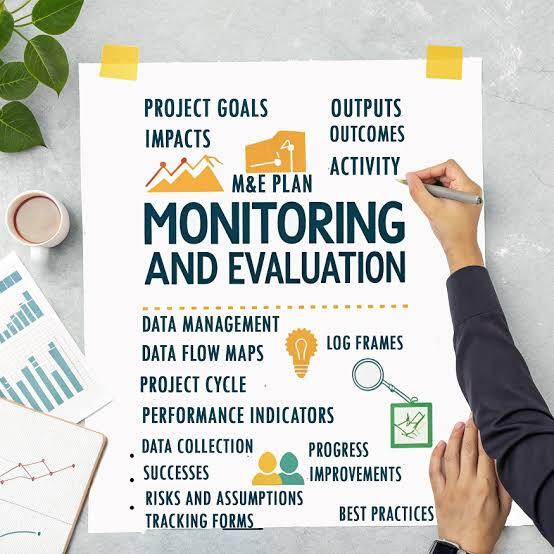
The M&E cycle is illustrated below.
Why M&E Matters
1. It Drives Better Decision-Making
With clear, reliable data, organizations can make informed choices — adjusting strategies, reallocating resources, and improving delivery in real time. Without M&E, you're essentially flying blind.
2. It Strengthens Accountability
Donors, funders, partners, and communities increasingly expect transparency and proof of impact. M&E provides the evidence needed to build trust and credibility.
3. It Fuels Learning and Growth
M&E isn't just about reporting results — it's about learning from them. When teams take the time to reflect on what’s working and what isn’t, they improve performance and innovate for the future.
4. It Measures What Matters
Good M&E ensures you're tracking the outcomes that align with your mission. It helps you focus on results — not just activities — so you can demonstrate meaningful change.
5. It Supports Sustainability
By identifying success factors and gaps, M&E helps programs evolve and scale responsibly. It provides the foundation for long-term planning and sustained impact.
M&E in the African Context
For African organizations, the need for strong M&E systems is especially urgent. With limited resources and vast development challenges, every effort must count. But too often, M&E is treated as an afterthought or a donor requirement — rather than a strategic asset.
At Pivot Intellect, we help organizations across sectors rethink M&E as a powerful tool for clarity, learning, and transformation. From building custom M&E frameworks to training teams and integrating digital tools, we tailor solutions that fit your goals and context.
Final Thoughts
Monitoring and Evaluation isn’t just about ticking boxes. It’s about knowing where you stand, where you’re going, and how to get there smarter. Whether you’re a nonprofit measuring impact or a business tracking performance, investing in M&E is investing in your success.
Want to build stronger M&E systems in your organization?
Contact us today — and let’s turn data into direction.
You can’t build impactful strategies in a vacuum. Whether you're launching a product, designing a policy, or scaling a nonprofit program, understanding the people who matter — and how they think — is essential. That’s where stakeholder intelligence comes in.
1. What is stakeholder intelligence?
It’s the systematic process of identifying, mapping, and analyzing stakeholders — from customers and funders to regulators and communities — to inform smarter decisions.
2. Why its a game-changer?
3. Use cases
Conclusion:
Stakeholder intelligence isn't just a research exercise — it’s a strategic advantage. The more you understand your ecosystem, the better your decisions.
Need help mapping your stakeholders or understanding your audience? Let’s start the conversation.

Data is everywhere, but insights are rare. That’s where AI steps in. Artificial intelligence is transforming the way organizations collect, process, and act on data — shifting us from hindsight to foresight.
1. From reports to real-time insights
AI automates data cleaning, structuring, and visualization, helping teams make sense of complex datasets in real time — no more waiting weeks for static reports.
2. Predictive Analysis
By analyzing historical patterns, AI models can forecast future trends — from customer churn to crop yields. This allows decision-makers to act proactively rather than reactively.
3. Natural Language Processing (NLP)
AI can analyze open-ended survey responses, online reviews, or social media to extract themes, emotions, and emerging concerns — turning qualitative data into actionable insights.
4. Anomaly detection
AI excels at spotting outliers in large datasets — such as fraudulent transactions, equipment failures, or public health risks — helping teams respond quickly to problems.
5. Democratizing Analytics
With user-friendly AI-powered tools, non-technical teams can access dashboards, ask questions in plain language, and explore data intuitively — increasing data-driven decision-making across organizations.
AI doesn’t replace analysts — it empowers them. By handling complexity at scale, AI frees humans to focus on strategy, storytelling, and ethical decision-making. Ready to bring AI-powered analytics to your organization? Connect with Pivot Intellect for a custom solution.

In an increasingly complex and resource-constrained world, organisations are under growing pressure to demonstrate the value and effectiveness of their interventions. Whether it's a community development project, a policy initiative, or a private sector investment in sustainability, impact assessment is the tool that helps us go beyond activity reporting to truly understand what works, for whom, and why.
But what exactly is impact assessment—and why should your organisation care?
Impact assessment is the systematic process of evaluating the intended and unintended changes—positive or negative—that result from a project, policy, programme, or intervention. Unlike routine monitoring, which tracks inputs and outputs, impact assessment goes deeper. It explores whether the changes that occurred can be attributed to your intervention, and whether they align with your original objectives.
Done well, impact assessment helps answer vital questions:
There is no one-size-fits-all method. Depending on your goals, timeline, and resources, an impact assessment may take various forms:
Choosing the right approach depends on your theory of change, the nature of your intervention, and what you want to do with the findings.
Impact assessment is not just a box-ticking exercise for donors or compliance. It’s a strategic tool that helps organisations unlock deeper understanding, drive better decisions, and amplify the value they bring to the world.
If you’re planning your next project or looking to reflect on your current strategy, now is the time to ask—not just what are we doing—but what difference are we making?
Need help designing an impact assessment for your programme?
At Pivot Intellect, we help organisations translate outcomes into insight and insight into impact. Let’s talk. info@pivotintellect.co.za
In today’s hyper-competitive, digitally driven economy, businesses can’t afford to grow by chance. Growth must be intentional, data-informed, and aligned with long-term goals. That’s where strategic business development comes in.
Too often, business development is mistaken for just sales or networking. In reality, strategic business development is far more holistic. It’s about creating the right opportunities with the right partners, in the right markets, at the right time—backed by insight, structure, and purpose.
Let’s break down what this really means.
Strategic business development refers to the deliberate, long-term planning and execution of activities aimed at expanding a business’s reach, impact, and profitability. It includes identifying new markets, refining your value proposition, building partnerships, improving service delivery, and aligning growth initiatives with overall business strategy.
It’s not just about generating more revenue. It’s about scaling intelligently—growing in ways that are sustainable, purpose-driven, and rooted in core strengths.
Strategic business development is not a luxury—it’s a survival strategy. In a climate of rapid change, organisations that lack a structured growth strategy are left reacting rather than leading.
Whether you're a startup entering new markets, an NGO expanding into new regions, or a consultancy growing its service portfolio, strategic development gives you the clarity, confidence, and capability to scale with purpose.
Strategic growth doesn’t happen overnight. But it starts with asking the right questions:
If you don’t have the answers yet, that’s where a growth strategy partner can help.
At Pivot Intellect, we support mission-driven businesses and organisations in shaping sustainable growth strategies that are rooted in insight, innovation, and stakeholder value. From business model refinement to client acquisition strategies—we help you grow on purpose, not by accident.
📧 Reach out: info@pivotintellect.co.za

For decades, USAID has been one of the most consistent sources of development funding around the world. From health systems and food security to governance and education, USAID-backed programs have saved lives, strengthened institutions, and built capacity in thousands of communities.
But times are changing.
With shifting U.S. foreign policy priorities, budget pressures, and rising global crises elsewhere, USAID funding is tightening—and for many NGOs, the writing is on the wall. Organisations that have long depended on U.S. government grants are facing delayed calls for proposals, shrinking award sizes, and in some cases, entire funding streams being phased out.
So the question is: What happens when the tap runs dry?
For many NGOs, USAID has represented stability. Its funding cycles are predictable, its frameworks familiar, and its reporting standards clear. But relying too heavily on a single funder—especially one shaped by geopolitics—is risky.
USAID's recent budget revisions are not a temporary glitch. They reflect a broader trend: donor fatigue, domestic-first politics, and a push toward localisation and private-sector engagement.
If your organisation hasn’t already started diversifying, the time is now. Because sustainability isn’t just about surviving the next funding cut—it's about thriving in a changing funding landscape.
Here are some of the top strategies forward-looking NGOs are exploring:
Large global funders like Ford Foundation, Open Society Foundations, and the Skoll Foundation are increasingly adopting flexible, long-term funding models that shift power to local actors. These donors want to support vision—not just compliance.
Tip: Build relationships, not just proposals. Share your learning journey, not just your impact metrics.
More investors are looking for organisations that can generate both financial returns and measurable social impact. If your NGO delivers services that create value—think education, renewable energy, or digital inclusion—consider spinning off a revenue-generating arm.
Tip: Package your impact like a business case. Speak the language of ROI and scale.
Many companies are ramping up ESG and CSR efforts. Strategic partnerships with the private sector—when values align—can bring in resources, technical expertise, and influence.
Tip: Focus on shared value. What societal issue can you tackle together?
While not a replacement for major grants, platforms like GlobalGiving, GoFundMe, and GiveDirectly offer visibility and a new donor base.
Tip: Tell compelling, authentic stories with strong visuals. Build trust through transparency.
Look to the EU, UK’s FCDO, GIZ (Germany), SIDA (Sweden), and regional development banks. Many offer funding aligned with localisation, climate action, gender equity, and innovation.
Tip: Tailor your language and approach. Different funders = different cultures and expectations.
As funding landscapes shift, NGOs need to act more like social businesses:
In a resource-tight environment, it's tempting to compete for shrinking funds. But real sustainability may come through networks, coalitions, and collective bids.
Explore:
USAID’s funding cuts are not the end of the road. They are a loud and urgent signal to evolve.
For NGOs that embrace innovation, agility, and diversification, the future holds promise. Those that continue to operate with outdated dependency models may find themselves left behind.
At Pivot Intellect, we support NGOs in designing funding diversification strategies, building donor intelligence systems, and creating value-driven program models that speak to today’s funders.
📬 Need help rethinking your funding future? Let’s talk: info@pivotintellect.co.za